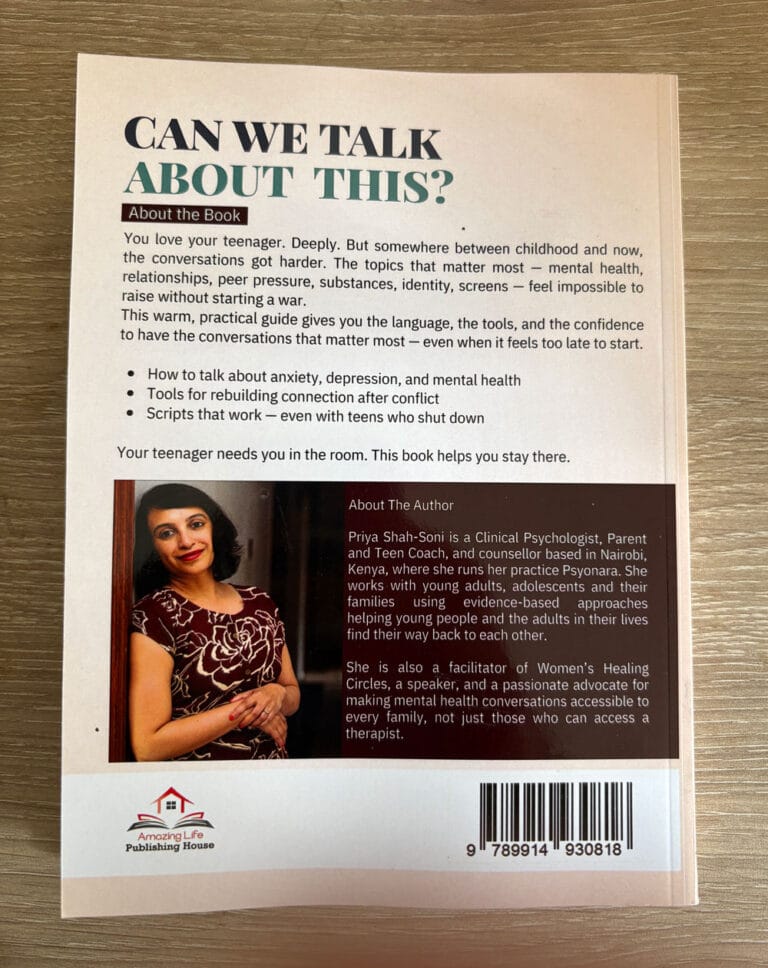
CAN WE
TALK ABOUT THIS?
PARENTS, TEENS, AND THE HARD CONVERSATIONS

A practical companion to each chapter
These aren’t tests. There are no wrong answers. Some questions will resonate immediately; others might take weeks to process. Return to them when you’re ready. Write in margins. Cross things out. Let them evolve with you.
Most importantly: be honest. Your teenager doesn’t need perfect parents. They need real ones.
When Did It Start?
Write down the first moment you noticed your child pulling away. Not when it became constant—the very first time.
The moment:
How old were they:
What you felt:
What you did:
Looking back, what do you wish you’d known then:
Your Emotional Landscape
Map where disconnection lives in your body. When your teenager withdraws, where do you feel it physically?
□ Tight chest
□ Clenched jaw
□ Stomach knot
□ Restless hands
□ Shallow breathing
□ Tension headache
□ Other: _________________
When you notice these sensations, what story does your mind tell you?
The Questions You Carry
Complete these sentences honestly:
When my teenager closes their door, I worry that…
When they don’t answer my questions, I assume…
When they choose their phone over me, it means…
The relationship I fear losing is…
The parent I’m afraid of becoming is…
Your Adolescent Self
What did you need from your parents at your teenager’s age?
What did you get instead?
How does that gap influence how you parent now?
What would teenage-you tell current-you about parenting?
Connection Inventory
When was the last time you felt genuinely connected to your teenager?
What were you doing?
What made that moment different?
Can you recreate those conditions? How?
The Pause Practice
This week, track how often you pause before responding to your teenager.
| Day | Situation | Did I pause? | What happened? |
|—–|———–|————–|—————-|
| Mon | | | |
| Tue | | | |
| Wed | | | |
| Thu | | | |
| Fri | | | |
| Sat | | | |
| Sun | | | |
What patterns do you notice?
When is pausing hardest?
What helps you remember to pause?
Brain Translation Guide
Reframe five recent “difficult” moments through the lens of adolescent neuroscience.
Moment 1:
What happened:
My interpretation:
Brain-based reframe:
Moment 2:
What happened:
My interpretation:
Brain-based reframe:
Moment 3:
What happened:
My interpretation:
Brain-based reframe:
Moment 4:
What happened:
My interpretation:
Brain-based reframe:
Moment 5:
What happened:
My interpretation:
Brain-based reframe:
Your Reaction Patterns
When your teenager snaps at you, you typically:
□ Snap back
□ Withdraw
□ Lecture
□ Question
□ Other: _________________
When they ignore you, you:
□ Pursue harder
□ Give up
□ Get angry
□ Feel hurt
□ Other: _________________
When they seem upset, you:
□ Fix immediately
□ Ask questions
□ Give space
□ Worry silently
□ Other: _________________
Which pattern serves you least?
Which pattern serves your relationship least?
What would you like to try instead?
The Regulation Check-In
Before your next difficult conversation with your teenager, assess yourself:
Physical state:
□ Calm
□ Tense
□ Tired
□ Activated
Emotional state:
□ Curious
□ Defensive
□ Worried
□ Frustrated
If you’re not regulated, what do you need before engaging?
□ Five deep breaths
□ Walk around the block
□ Talk to a friend
□ Write in journal
□ Other: _________________
Your Digital Habits
Be brutally honest about your own technology use.
Average daily screen time:
Apps you check most frequently:
Times you reach for your phone instead of sitting with discomfort:
How your teenager might describe your digital habits:
What you’d change if you could:
Boundary Experiments
Choose ONE boundary to try for one week. Just one.
My boundary: ___________________________________
Why this one:
Potential obstacles:
Support I’ll need:
How I’ll track it:
Daily Log:
| Day | Did I maintain it? | What made it easy/hard? |
|—–|——————-|————————|
| 1 | | |
| 2 | | |
| 3 | | |
| 4 | | |
| 5 | | |
| 6 | | |
| 7 | | |
Reflection:
Will I continue? Modify? Release?
Family Technology Agreement
Draft collaboratively with your teenager. This isn’t rules imposed—it’s agreements made together.
Device-free times we both agree to:
Charging station location and time:
Emergency exceptions:
Code words for “I need help with my digital habits”:
Consequences we both accept for breaking agreements:
Review date (revisit monthly):
The Dopamine Audit
Help your teenager (and yourself) identify what triggers reward-seeking.
What activities light up your brain in healthy ways?
What apps/activities feel compulsive?
When do you reach for your phone without thinking?
What unmet need is the phone filling? (Boredom? Connection? Avoidance?)
What could meet that need differently?
Depletion Assessment
Rate yourself honestly (1=never, 10=constantly):
| I feel exhausted before the day begins | 1 2 3 4 5 6 7 8 9 10 |
|I snap at small things | 1 2 3 4 5 6 7 8 9 10 |
|I resent my teenager’s needs | 1 2 3 4 5 6 7 8 9 10 |
|I fantasize about running away | 1 2 3 4 5 6 7 8 9 10 |
|I can’t remember my last moment of joy | 1 2 3 4 5 6 7 8 9 10 |
|I feel invisible in my own home | 1 2 3 4 5 6 7 8 9 10 |
Total score:
0-20: You’re managing, but stay vigilant
21-40: Depletion is present; prioritize refilling
41-60: Crisis level; seek immediate support
Refilling Practice
This week, I will do ONE thing just for me:
When:
What might interfere:
How I’ll protect this time:
Did I do it?
How did it feel?
What changed (even slightly) afterwards?
Emotion Naming
Practice naming your feelings without acting on them.
This week, when I felt triggered by my teenager:
| Situation | Body sensation | Emotion name | What I did | What I wanted to do |
|———–|—————|————–|———–|——————-|
| | | | | |
| | | | | |
| | | | | |
Patterns I notice:
Repair Script
Keep this somewhere accessible for after you mess up (not if—when).
“I shouldn’t have [specific behaviour]. I was [name your emotion], but that wasn’t fair to you.”
Example from this week:
How your teenager responded:
What you learned:
The Grief Acknowledgment
What version of your child are you grieving?
What moments do you miss?
What’s actually lost versus what’s transformed?
How can you honor both the grief and the growth?
Your AI Usage
When do you turn to AI/Google instead of trusting your instincts?
What parenting questions have you asked AI this month?
What were you really seeking? (Information? Reassurance? Permission?)
How did the AI response make you feel?
Did it actually help, or just temporarily relieve anxiety?
Building AI Bridges
Ask your teenager (with genuine curiosity):
“Do you ever use AI to figure things out?”
“What do you like about it?”
“Is there anything you’ve asked AI that you wish you could ask me?”
Their responses:
Your response (regulate first):
The Three-Second Response
Practice this before every interaction this week.
When your teenager shares something:
| What they said | My impulse (honest) | What I actually said | Result |
|—————|——————-|———————|——–|
| | | | |
| | | | |
| | | | |
What gets easier with practice?
Curiosity Over Judgment
Transform your typical questions into curious ones.
Instead of: “Why are you always on your phone?”
Try: “What are you into right now? I’m genuinely curious.”
Instead of: “Did you do your homework?”
Try: “How’s the workload feeling today?”
Instead of: “Who are you texting?”
Try: “Good conversation?”
Your transformations:
Old question:
New question:
Old question:
New question:
Old question:
New question:
Authenticity Check
When was the last time you created something imperfect and shared it anyway?
What stops you from showing your messy process?
How do you model “good enough” for your teenager?
What could you try (and fail at) in front of them this week?
Comparison Awareness
Help your teenager (and yourself) notice comparison patterns:
Who/what do you compare yourself to most?
When does comparison feel worst?
What does comparison steal from you?
What would change if you stopped for one day?
The Struggle Story
Share a time you struggled with something and eventually succeeded (or didn’t):
What made it hard:
What you learned from the difficulty:
Why the struggle mattered:
Tell this story to your teenager this week. Their response:
Value Sorting
Sort your household rules into categories:
Non-negotiable values (why):
Cultural preferences (could flex):
Fear-based restrictions (honest assessment):
Rules I inherited without examining:
The Negotiation Table
One freedom your teenager wants:
Your honest fear:
Their proposed accountability:
Experiment parameters (time-limited trial):
Review date:
How it went:
Your Adolescent Secrets
What did you hide from your parents?
Why couldn’t you tell them?
Would you want your teenager to tell you similar things?
What would make that possible?
Code-Switching Recognition
Observe your teenager moving between contexts (home, school, friends):
What changes?
What stays the same?
How might that be exhausting?
How can you make home a place they don’t have to perform?
Relationship Readiness
When your teenager mentions someone new:
Your immediate internal reaction (honest):
Your actual response:
What you wish you’d said:
What you’ll try next time:
The Story Share
Your first heartbreak/crush/meaningful friendship at their age:
What you felt:
What you needed:
What you got:
Share this with your teenager (no moral attached). Their response:
Creating Safety
How does your teenager know it’s safe to share relationship stuff with you?
Evidence from their perspective:
What might make it unsafe:
One thing you’ll change this week:
Red Flag Awareness
Without panicking, what patterns would concern you:
□ Sudden isolation from friends
□ Dramatic appearance changes
□ Constant phone anxiety
□ Excessive apologizing
□ Refusing to discuss certain people
□ Visible fear around notifications
If you notice these, you will:
Your History
Your first encounter with substances:
Who you told:
Who you didn’t tell (and why):
What you wish you’d known:
What you wish your parents had done differently:
The Safety Talk
Script for establishing code words:
“If you’re ever in a situation where you feel uncomfortable or unsafe—substances or anything else—text me [word/emoji] and I’ll call with a fake emergency. No questions, no lecture, just rescue.”
Your code word/emoji:
Date you established this:
Have they used it:
Non-Negotiables
The only rules that matter around substances:
Never get in a car with an impaired driver (we will come, always)
Never leave an intoxicated friend alone
Call emergency services if anyone loses consciousness
Everything else is conversation, not commandment
The Story You’ll Share
Choose one honest experience from your adolescence involving pressure, choices, or substances:
What happened:
What you felt:
What you learned (not what you want them to learn—what you actually learned):
Tell this story this week. No moral. Just humanity.
Response Regulation
If your teenager comes to you about substance use (theirs or a friend’s):
Before responding, I will:
□ Take three breaths
□ Thank them for trusting me
□ Ask if anyone needs medical attention
□ Separate immediate safety from later conversation
I will NOT:
□ Panic
□ Lecture immediately
□ Make it about my feelings
□ Forbid future honesty through my reaction
Not Success—Progress
Six months ago, my relationship with my teenager looked like:
Today it looks like:
Small moments of connection this month:
Times I regulated when I wanted to react:
Repairs I’ve made:
What I’m still struggling with:
What I’m releasing:
What I’m beginning to trust:
The Only Question That Matters
If my teenager needed me at 2am—truly needed me—would they call?
Honest answer:
If not, what needs to change:
First step:
Permission Slip
Sign and keep somewhere visible:
I, _________________, give myself permission to be an imperfect parent raising an imperfect human in an imperfect world. I release the fantasy of doing this perfectly. I commit to showing up, repairing when I fail, and trusting that steady presence matters more than flawless execution.
I am enough.
Signed: ___________________
Date: ___________________
Notes Pages
Use these for observations, breakthroughs, questions that arise, or just venting when it’s hard.
These worksheets aren’t meant to be completed in order or all at once. Return to them. Let them evolve. Some weeks you’ll write pages. Some weeks you’ll leave them blank.
Both are fine.
This work isn’t linear. Neither is healing. Neither is parenting.
You’re doing better than you think.
Fusce sagittis ligula enim, sit amet lobortis odio tempor at. Quisque ex mi, commodo quis augue quis, maximus fringilla orci. Proin accumsan euismod nibh sed condimentum morbi porttitor, nulla et sodales blandit.
"Thanks to the supportive team, I’ve learned how to manage my anxiety and feel more in control of my life. I’m truly grateful for the care and guidance they provided."

Quick info